Blasts From The Past
Six minor planets — three of them named — a cardboard telescope, and a survey technique that was not supposed to be possible from a back garden.
A four-digit observatory code is the Minor Planet Center saying your measurements count.
EverStaR Observatory sat in Olathe, Kansas — a roll-off roof in the suburbs, not a mountaintop. It ran unattended: multi-target imaging, plate solving, robotic pointing, and weather safing, on a schedule, through the night. The work split two ways. Deep-sky photography for its own sake, and minor planet astrometry for the Minor Planet Center, where an amateur's arcseconds are worth exactly as much as anyone else's if they are right.
Discovered with Gina Fedon. Three carry citations and names; three carry designations and a closed window.
The count is six, not three. These three were found the same way, from the same observatory, by the same people:
Names were submitted for them. They were not granted, because the Minor Planet Center changed its naming rules in the years that followed — the window that had been open for the first three closed before these three reached it.
There is no appeal in that and no grievance in it either. It is simply how the timing fell: the same telescope, the same technique, the same nights, and three of the six happen to carry names because they were finished first. The other three exist in the record as designations and nothing more.
Worth saying plainly, since a list of names invites the wrong count: six minor planets were discovered here. Three of them are called something.
Drift scanning, on a Dobsonian, in the 1990s.
In the late 1990s, time-delay integration was survey-platform technology. Spacewatch had it on a 0.9-metre at Kitt Peak. Early SDSS prototypes had it. The idea that you could do it on consumer equipment was, at best, an argument.
A Meade 16-inch Starfinder Dobsonian. A cardboard Sonotube for a tube, a particle-board rocker box, Teflon bearings, Lumicon encoders and COSMIC ONE digital setting circles. Roughly the least likely survey instrument in North America.
Rather than buy an expensive high-payload equatorial mount with sub-arcsecond tracking, the Dob was used as a stationary light bucket. Point it at a declination and leave it. The Earth turns, the sky sweeps past the focal plane, and the CCD clocks charge line by line at exactly the rate the stars move. The mount that could not track became a mount that did not need to.
Three problems, none of them optional. The sensor columns had to sit exactly parallel to celestial motion, or every star in the frame trails diagonally. The pixel readout clock had to be tuned to millisecond precision against the declination cosine — the sky moves slower the further north you point, and the camera has to agree. And a chilled camera hung on a cardboard tube introduces focuser flexure and thermal settling that will quietly walk your collimation off through the night.
It worked. The camera came off Everstar One when a drift scan was running — the Tech Info archive still carries the note, on the entry for Everstar Scope Three: “Uses Camera from Everstar One when Driftscanning.”
Powell Observatory, Louisburg, Kansas.
The Ruisinger 30-inch Newtonian at Powell Observatory is among the largest amateur equatorial telescopes in the United States. It had never been drift scanned. Getting it there meant solving mechanical drive backlash, focal-plane alignment and clocking synchronisation for wide-field strip scanning — the same three problems as the Dob, at ten times the moment of inertia.
Hardware was provided and the capability demonstrated. The Astronomical Society of Kansas City then used that working pipeline as the evidence in a successful application to the NASA Office of Space Science. The grant bought an Apogee AP-8: a 1024×1024 back-illuminated SITe sensor, dedicated to Near-Earth Object searches and astrometric follow-up.
A proof of concept on a cardboard tube ended with a research camera on a 30-inch, paid for by NASA.
Work with Adam Block at the Kitt Peak National Observatory Visitor Center's Advanced Observing Program: CCD calibration, deep-sky acquisition, signal reduction and data processing, during the years when astronomy was crossing from emulsion to research-grade digital sensors.
Consulting and data-reduction pipeline work for follow-up astrometric recovery. Wide-field survey passes in the Cerro Tololo and La Silla corridor turn up objects on short orbital arcs, and a short arc degrades fast — recover it within days or the object is simply lost again. The work was orbit calculation assistance, ephemeris uncertainty refinement, and coordinate hand-offs to whoever had sky.
Two books put EverStaR in front of readers. Both are worth your money; here they are.
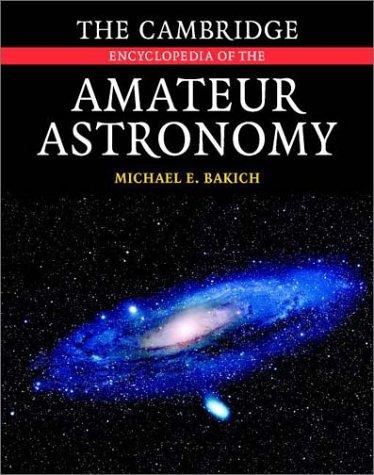
Michael E. Bakich · Cambridge University Press, 2003
ISBN 978-0521812986
EverStaR appears in Chapter 20, “Observatories”, as an example of a highly automated amateur research observatory doing scientific-grade CCD imaging and minor planet discovery.
Przewodnik młodego astronoma
Przemysław Rudź · Wydawnictwo Pascal
EverStaR was featured in a section on modern private observatories — suburban automation, remote scripting, dome synchronisation, and MPC 849 astrometry — for a Polish readership who had never seen the place.
Both covers and texts remain the copyright of their authors and publishers: © Michael E. Bakich and Cambridge University Press; © Przemysław Rudź and Wydawnictwo Pascal. They are shown here only to identify the books and to point readers at them. Thank you both for the feature — being written about by people who knew the subject was an honour then and still is. If this page sends anyone to a copy of either book, that is the point. The Cambridge cover image is served from the Open Library cover archive. No cover was available for Niebo na weekend from an open source, so none is reproduced here rather than taking one from a retailer.
A full mobile observatory built inside a heavy-duty cargo trailer — warm room, power distribution, computer workstations, and the capacity to move large-aperture optics, up to a 24-inch Dobsonian, out to dark sky anywhere in the Midwest. It has been described as the James Bond equivalent of an astronomy trailer, and that is about right.